Featured


  • Nyckelharpa

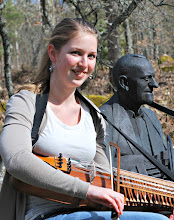
    The nyckelharpa is an intriguing Swedish folk music instrument. .Several hypothesises exist about its origin: is it brought from Germany, or perhaps from Belgium? Or is it a genuine Swedish 'invention'?


  • Early church paintings

    Depictions in churches of angels playing nyckelharpa show that the instrument had a certain status in the Middle Ages. Early paintings are mainly found in Sweden. This photo is made in Tolfta, Uppland.


  • Early church paintings

    Tolfta, Uppland.


About the Blog

Hi, welcome on my blog about the nyckelharpa! I'm Janine Buisman, musicologist, IT project manager, garden designer and above all a nyckelharpa player from the Netherlands.

With this blog I want to give you a source of information regarding the nyckelharpa. Here you can find blog posts about the instrument in general, on (coming) workshops and courses, music with or for nyckelharpa, interesting literature, etc. Feel free to comment - and enjoy!

Would you like to contact me? Please leave a message in the contact form below.

Wednesday, 27 December 2023

Nyckelharpa Network: A Triumph for Swedish Cultural Heritage

0 reacties

In a momentous achievement, the Nyckelharpa Network has been inscribed into the UNESCO Register of Good Safeguarding Practices for Intangible Cultural Heritage (website). This prestigious recognition, bestowed in December 2023, acknowledges the network's efforts to preserve and promote the music and traditional craftsmanship of the nyckelharpa. The network's innovative approach to safeguarding the instrument's cultural heritage, including training programs, workshops, and community engagement initiatives, has been recognized as a model for other cultural practices worldwide. This significant achievement not only celebrates the nyckelharpa's rich cultural significance but also underscores the importance of preserving traditional music and cultural practices for future generations.

The Nyckelharpa: A Unique Musical Journey

The nyckelharpa has a fascinating history dating back to the late medieval period, it has endured as an unbroken tradition. What sets the nyckelharpa apart is not only its hauntingly beautiful sound but also the intimate connection between its players and the instrument-making process. Unlike many other instruments, there are a quite lot of nyckelharpa players who also craft their own instruments, ensuring a seamless blend of artistry and craftsmanship.

Esbjörn, The Driving Force

At the heart of this achievement stands Esbjörn Hogmark, a nyckelharpa master builder and player from Uppland. Esbjörn’s passion for the instrument led him to co-found the Eric Sahlström Institute (ESI) in 1998, where he continues to serve on the board. His dedication extends beyond playing and making nyckelharpas; he has been the mastermind behind the successful application to have the Nyckelharpa Network recognized as intangible cultural heritage.

Watch the application video here:


Esbjörn’s tireless efforts culminated in the Nyckelharpa Network’s inclusion in the UNESCO Register. The Swedish government submitted the proposal during the eighteenth session of the Intergovernmental Committee for the Safeguarding of the Intangible Cultural Heritage in Kasane, Republic of Botswana. An evaluation body meticulously assessed the application, leading to a plenary assembly vote in favor of the Nyckelharpa Network’s inscription.

Impact and Significance

  • Preserving Tradition: The UNESCO recognition acknowledges the importance of passing down this unique heritage to future musicians and instrument-makers. And therefore ensures that nyckelharpa music and craftsmanship will be safeguarded for generations to come.
  • Global Visibility: Inclusion in the Register elevates the Nyckelharpa Network’s profile on the international stage. It invites curiosity, research, and collaboration from musicians, scholars, and enthusiasts worldwide.
  • Cultural Pride: For Sweden, this inscription is a celebration of the rich cultural heritage that defines Sweden's identity. It reaffirms the country’s commitment to preserving its cultural identity and celebrating its artistic heritage.
  • Inspiration for Creativity: The nyckelharpa’s recognition inspires contemporary musicians to explore its possibilities, infusing new life into an ancient tradition.

Conclusion

As the Nyckelharpa Network takes its rightful place among the world’s cultural treasures, we celebrate Esbjörn Hogmark’s unwavering dedication. His vision, combined with the harmonious resonance of the nyckelharpa, ensures that this musical legacy will resonate across time and borders.


Thank you video of the Nyckelharpa Network:


Sources:


Read more

Sunday, 1 January 2017

Workshops 2017

2 reacties
Eager to improve your nyckelharpa playing, learn some new tunes, or meet other nyckelharpa players? Then workshops are a wonderful place to go to with your instrument! Also when you'd like to start playing nyckelharpa there several workshops each year for beginners (f.e. at Burg Fürsteneck or Halsway Manor). Below you'll find the nyckelharpa workshops of the year 2017 worldwide, as well as workshops given by nyckelharpa players (f.e. combined with violins). Missing the mention of a workshop? Additions are most welcome, so please let me know!

Later in the year, a list with workshops in 2018 will follow as well. So keep an eye on this blog!

January

Germany:

17th Fürstenecker Bordunale

Date: 1 - 4 January 2017
Location: Burg Fürsteneck, Am Schlossgarten 3, D-36132 Eiterfeld (DE)
Teacher: Annette Osann (FR/DE) and Josefina Paulson (SE)

From 1st to 4th January 2017, the Fürstenecker Bordunale takes place again, inter alia, with a nyckelharpa workshop with Annette Osann (France / Germany) and an ensemble workshop for Swedish music with Josefina Paulson (Sweden).

February


March

United Kingdom

Beginners Halsway Weekend 2017

Website: http://nyckelharpa.me.uk/halsway/beginners-halsway-weekend-march-2017/
Date: 10-12 March 2017
Location: Halsway Manor, Taunton, Somerset TA4 (UK)
Teacher: Vicki Swan

"A full-on, fun packed workshop weekend for beginners as well as more experienced players of this unusual Swedish folk stringed instrument. Workshops will cover all aspects of playing the nyckelharpa: posture, technique, bowing, Swedish tunes, British tunes, chord playing ensemble playing (by ear), and exercises."

April

Belgium:

Swedish Music Course for Violin and Nyckelharpa

Date: 28 April - 1 May 2017
Location: De Lindenpoorte, Korte Veldstraat 7, 8600 Esen (Diksmuide) (BE)
Teacher: Magnus Holmström

Twenty hours of music with Magnus Holmström for nyckelharpa and violin players, plus a surprising activity and of course jam sessions! All in the sympatic atmosphere of 'De Lindenpoorte' in Esen.

Germany:

Nyckelharpa Weekend in Altenmünster

Date: 28 - 30 April 2017
Location: Maria Ward Haus EpphishoferstraBe 18 86450 Altenmünster (DE)
Teacher: Markus Svensson (SE) and Johannes Mayr (DE)

Two parallel nyckelharpa courses will be given in Altenmünster: 

1. Beginners course by Johannes Mayr: By using simple melodies from different folk traditions and early music posture, bowing technique and fingering are taught. A limited number of loan instruments are available.

2. Swedish folk music on the nyckelharpa by Markus Svensson: The course is aimed at intermediate to advanced nyckelharpa players. Markus' repertoire is a mixture of music from Western Sweden, Uppland and Gotland.

More information and application: Johannes Mayr (e-mail).

The Netherlands:

Workshop weekend nyckelharpa

Website:  www.draailier-doedelzak.nl
Facebook: www.facebook.com/events/1669388766667664/
Date: 1-2 April 2017
Location: De Zonnewende, Esscheweg 78, 5271 NA, Sint-Michielsgestel (NL)
Teacher: Koen Vanmeerbeek

"Participants will taken a step further into nyckelharpa playing. During this course participants will examine for instance different playing techniques, styles and your position during playing. Koen will use melodies from Sweden, France, Belgium and new compositions to work on variations, ornamentation and the use of chords.
Koen plays the nyckelharpa since 1999. He followed courses by Didier François, Olov Johansson, Daniel Pettersson and Eléonore Billy. He works as a composer and plays violin and nyckelharpa in the band Dr. Eugène."

May


June

Sweden

Course at Ekebyholm for Nyckelharpa and Violin
Website: ...
Date: ... June 2017
Location: Ekebyholm Castle, 762 91 Rimbo (SE)
Teachers:

"Låtkursen på Ekebyholm startade 1976 med Eric Sahlström och Gösta Sandström som lärare. Varje år utser Eric Sahlströms Minnesfond några unga spelmän i åldrarna 13–20 år till stipendiater. Förutom en kursplats på Låtkursen på Ekebyholm är det en stor ära att bli utsedd till ”Sahlströmstipendiat” och hittills kan 100 personer titulera sig så! Många stipendiater kommer också tillbaka, både som kursdeltagare och som lärare."

July


August

Italy

Masterclasses Early Music and Nyckelharpa

Website: http://www.bertinoromusica.it/corsi/?page_id=23 
Date: ...-... August 2017
Location: Scuola Musicale Dante Alighieri, Via Colombarone, 325, Bertinoro FC (IT)
Teacher: Marco Ambrosini

"This masterclass is aimed at the more advanced nyckelharpa / viola d’amore a chiavi player and requires preparation using previously sent sheet music. It will be based on the resolution of the questions of performance of early music on our instrument; forming the sound, articulation, phrasing, consort play and vocal accompaniment will be the main subjects of this masterclass."

September


October

Germany:

13th International Days of the Nyckelharpa at Burg Fürsteneck

Website: www.nyckelharpa.burg-fuersteneck.de/nyckelharpa_eng.htm
Date: 5-9 October 2017
Location: Burg Fürsteneck, Am Schlossgarten 3, D-36132 Eiterfeld (DE)
Teachers: ...

The 14th International Days of the Nyckelharpa takes place from 6 to 9 October 2017 at Burg Fürsteneck in Eiterfeld, Germany. Several parallel workshops on different levels and subjects are offered. Plus: additional short workshops, nyckelharpa exhibition with many instrument makers, nyckelharpa conference, informal exchanges and play together.

November


December


Read more

Thursday, 13 October 2016

13th International Days of the Nyckelharpa

0 reacties
Every year in October the castle Burg Fürsteneck in central Germany is filled with nyckelharpa players from all over the world. They all come for the International Days of the Nyckelharpa where you can join continuous and short nyckelharpa workshops on different topics.

Quite often I heard people enthusiastically speaking about this annual event, but so far I'd never attended it, yet. After having played nyckelharpa for almost six years, it's definitely time to go there! Getting there did initially not go particularly smoothly due to car problems: instead of travelling for about 6 hours, it took almost 12 hours to get there... But wow, the weekend was definitely worth the long trip! Around 80 nyckelharpists from 13 different countries all crammed together into the medieval castle in Eiterfeld.

Workshop Didier François (Photo by Karsten Evers)
After the welcome speech and the introduction of all the wonderful teachers, the workshops started in the late evening. This years teachers were Ana Alcaide (ES), Marco Ambrosini (IT/DE), Jule Bauer (DE), David Eriksson (SE), Didier François (BE), Magnus Holmström (SE), Johannes Mayr (DE), and Annette Osann (FR). I had the privilege of taking part in the workshop given by Didier François on "Groovy arrangements and improvisations on European folk music". During his workshop many different aspects of playing were discussed: from improvisation techniques on scales and arpeggios to intrinsic motivation (f.e. the power of thinking positive). In the group we worked on a.o. blues and folk music from Macedonia, Bulgaria, Hungary and Bosnia - so different from the traditional Swedish folk music I normally play on nyckelharpa.

On Friday and Saturday afternoon everyone had the opportunity to take part in short workshops of about an hour, with the same or another teacher. I first took part in the short workshop by Marco Ambrosini on polyrythmical playing (like gamelan music from Indonesia). At first this polyrhythmical playing felt so unnatural, but at the same time very intriguing! Really fun to play together in this way! Next day I chose the short workshop by Ana Alcaide. She taught us two beautiful sephardic songs. Personally, I especially love the melody of Por que llorax blanca niña.

The surrounding landscape
For some fresh air and movement there was also enough opportunity during the lunch breaks. The weather was perfect for a delightful walk through the sunny fields of Eiterfeld. Dark blue clouds at the horizon gave even more autumnal colour to the beautiful hilly landscape.

Getting bored at Burg Fürsteneck is just impossible! Even in the evenings there's lot to do, see, play, listen, or people to meet. Friday evening started with the interesting Nyckelharpa Conference on recent developments. First Magnus Holmström discussed the in Sigtuna found object from the 12th century, which very likely might be a nyckelharpa key! Although many objects were discovered during the excavation besides the market, only one key was found, or preserved. I'm curious what a carbon dating will tell us more. Next Per-Ulf Allmo spoke about his newly written publication on the history of the nyckelharpa, titled 'Framlades then stora Nycklegijga: En avhandling om den svenska nyckelharpans tillkomst'. Although I haven't finished reading it yet, I can highly recommend his book. The book, though, is only published in Swedish but in time a summary in English (and probably also in German) will follow.

Teachers concert (Photo by Karsten Evers)
After another wonderful workshop day, the hall of the castle swiftly filled with visitors for the concert Saturday evening. The concert started with the participants of the European Nyckelharpa Training, from both the Italian as the German track. The second part of the concert was given by the teachers. Wow, the concert was sooo beautiful! During the whole event there was also a nice exhibition/forum for builders where you could try other instruments and bows. I was impressed by the beautiful snakewood bows made by the French bow maker Aurélie Georges. And of course, what's a music weekend without wonderful jam sessions until very, very late!? Learned some lovely new tunes there after midnight.

All by all, the International Days of the Nyckelharpa is a perfect event to learn more about the versatility of the instrument, try other nyckelharpa's and bows, listen and play beautiful music, and meet amazing people. Don't doubt, go there next year!

The final presentation of all workshop groups (Photo by Karsten Evers)


Read more

Monday, 11 July 2016

Study nyckelharpa

0 reacties
Especially when you're living outside Sweden, it's often hard to find a way to intensively learn to play the nyckelharpa very well. Sometimes you're lucky to have a teacher in you're own country, but more often you don't. Though, there are ways to immerse yourself in nyckelharpa! Besides private lessons and workshops you can also study nyckelharpa for a longer period.

Personally, I consider the year I went to the Eric Sahlström Institute (ESI) in Tobo, Sweden, as the most amazing year of my life. Immersing yourself with nyckelharpa (or fiddle), traditional Swedish folk music and dance with fantastic teachers and highly motivated fellow students is a wonderful experience. Time passes quickly but you learn a lot and meet so many amazing people. So, I can highly recommend a year at ESI!

Below you can find information on long term nyckelharpa courses/studies in Europe. For short term workshops/courses, please take a look at the workshop page.

Courses

Eric-sahlström-institute-photo-by-janine-buisman
Eric Sahlström Institute

Eric Sahlström Institute

Website: http://esitobo.org/
Duration: 1 year
Location: Tobo, Sweden
Main Teachers: Olov Johansson, Ditte Andersson, Sonia Sahlström, Niklas Roswall (arranging), and Mia Marin (violin)

The Eric Sahlström Institute (ESI) is a Swedish national center for traditional music and dance, with the nyckelharpa as special endeavor. The ESI’s educational programs in traditional Swedish music and dance offer the finest musicians and dance leaders in Sweden. ESI provides year-long courses in nyckelharpa, fiddle and dance. These courses offer the opportunity to learn the fundamentals of their compelling and rich tradition, to broaden repertoire and deepen technical skills. At ESI they teach their students to express themselves in the language of traditional Swedish music and dance.

European Nyckelharpa Training

Burg-fürsteneck-photographer-unknown
Burg Fürsteneck (Photo by: unknown)
Website: www.training.nyckelharpa.eu
Duration: ca. 3 years
Location: Burg Fürsteneck (Germany) and Scuola di Musica Popolare di Forlimpopoli (Italy)
Main Teachers: Marco Ambrosini, Ditte Andersson, Jule Bauer, Didier François, and Annette Osann

The European Nyckelharpa Training (ENT) at Academy Burg Fürsteneck (Germany) and at the Scuola di Musica Popolare di Forlimpopoli (Italy) strives to enable the students to play the nyckelharpa at a rather high level in concerts and/or to teach it competently or play it for their private use depending on the personal emphasis.

KMH Stockholm (Royal College of Music)

Kungliga-musikhogskolan
KMH (Photo by: unknown)
Website: http://www.kmh.se/kmh-10000_en
Duration: 3 years (BA), 1-2 years (MA)
Location: Stockholm
Main Teachers: Olov Johansson, Torbjörn Näsbom, and Ditte Andersson

At the Kungliga Musikhögskola (KMH) in Stockholm you can study a Bachelor in Swedish folk music (performance) on nyckelharpa. Courses within the main subject are: 'Main instrument', 'Ensemble', 'Arranging', 'Playing to dance', 'Stage training', 'Concert practice', and an 'Independent assignment for exam'.

Read more

Thursday, 7 July 2016

Read, watch & learn

0 reacties
In finishing my bachelor study in Musicology at the University of Utrecht in 2011, I wrote my thesis on the global development of the nyckelharpa. Below you'll find the literature specifically regarding the nyckelharpa which I've used for my thesis, plus new publications and literature regarding playing and building. So, material which might be interesting or useful to you.

Are you missing something in the listing? Please let me know.

Literature

  • Ahlbäck, Gunnar (1980). Nyckelharpfolket: om nyckelharprörelsen, en 1970-talsföreteelse, historia och bakgrund, framväxt och utbredning. Stockholm: LTs förlag.
  • Ahlbäck, Gunnar, ed. (1992). Boken om Eric Sahlström. Tierp: Eric Sahlströms Minnesfond.
  • Ahlbäck, Gunnar, Fredelius, Gunnar, en Jan Ling (1991). Nyckelharpan nu och då/The Nyckelharpa Present and Past. Stockholm: Musikmuseet.
  • Allmo, Per-Ulf (2016). Framlades then stora Nycklegijga: En avhandling om den svenska nyckelharpans tillkomstTullinge: Tongång.
  • Allmo, Per-Ulf (2004). Den gäckande nyckelharpan: En studie i instrumentets tillkomst. Tullinge: Tongång.
  • Andersson, Otto E. (1930), The bowed-harp: A study in the history of early musical instrumentsLonden: William Reeves.
  • Boström, Mathias (1999). Nyckelharpan och nätet: om sociala och elektroniska nätverk kring nyckelharpan. Stockholm: The Royal Swedish Academy of Music.
  • Eriksson, Maj-Britt (1956). Melodi på nyckelharpa. Stockholm.
  • Evers, Karsten (Ed.) (2011). CADENCE: Cultural adult education and nyckelharpa cooperation in EuropeVerlag der Spielleute / Förlaget Tongång.
  • Hettrick, William (1994). The ‘Musica instrumentalis deudsch’ of Martin Agricola. A treatise on musical instruments, 1529 and 1545. Cambridge: Cambridge University Press.
  • Hogmark, Esbjörn (2020). Nyckelharpan: ett unikt svenskt kulturarv. Göteborg: Bo Ejeby Förlag.
  • Isaksson, Olov (1998)Vallonbruksminnen. Stockholm: En bok för alla.
  • Leffler, Karl Peter (1899). Om nyckelharpospelet på Skansen. Stockholm: Nordiska Museet.
  • Ling, Jan (1976). Nyckelharpan. Studier i ett folkligt musikinstrument. Stockholm: Bokförlaget Prisma.
  • Ling, Jan (1997). A History of European Folk MusicRochester: University of Rochester Press.
  • Praetorius, Michael (1619). Syntagmatis musici tomus secundus: De organographia. Wolfenbüttel. Facsimile reproduction by Wilibald Gurlitt (Kassel: Bärenreiter, 1958).
  • Ralyea, John (1980). Shepherd's delight: guide to repertoire for hurdy-gurdy, musette (bagpipes), organized hurdy-gurdy, wheel-fiddle, keyed fiddle (nyckelharpa), and marine trumpet. Chicago: The Hurdy-Gurdy Press.
  • Risberg, Bernhard (1908). På nyckelharpa och violin. Stockholm: Ljus.
  • Tärnström, Anne-Marie (1994). Nyckelharpan: en bibliografiVällingby.
  • Virdung, Sebastian (1511). Musica getutscht und ausgezogen durch Sebastianum Virdung Priesters von Amberg und alles Gesang auss den Noten in die Tabulaturen diser benanten dryer Instrumenten der Orgeln, der Lauten und der Flöten transferieren zu lernen Kurtzlich gemacht zu Er-en den hoch wirdigen hoch gebornen Fürsten  und herren: Herr Wilhalmen Bischove zü Straszburg, seynem gnedigen herren. Basel: Michael Furter.

 Articles

  • Abbot, Djilda, & Ephraim Segerman, 'Strings in the 16th and 17th Centuries', Galpin Society Journal vol. XXVII, 1974; corrected: Northern Renaissance Instruments, Research Report No.2Manchester, September 1974.
  • Allmo, Per-Ulf. “Moraharpans väg till Mora: ett bidrag til frågan om Dalaharpornas ålder  och härkomst.” Musikk og tradisjon: tidsskrift for forskning i folkemusikk og folkedans 24 (2010), pp. 100-129.
  • Engsås, Jan. “Som nyckelharpa bland svartrockarna: en introvert betraktelse”, Nyckelposten (1994), pp. 4-6.
  • Fichtenbaum, Matt. “The nyckelharpa: Sweden's unique folk instrument”, Fiddler magazine (1996), pp. 29-31.
  • Fredelius, Gunnar. “VM i nyckelharpa 1996”, Nyckelharpan (1996), pp. 11-13. 
  • Fredelius, Gunnar. “VM i nyckelharpspel”, Nyckelposten (1994), pp. 8-12.
  • Hedin, Johan. "Tenornyckelharpan - en udda figur i nyckelharpvärlde." (2004). Click here for the article.
  • Hedin, Johan. "The Tenor Nyckelharpa – a new presence in the nyckelharpa world." (2004). Click here for the article.
  • Hedin, Johan. "Lutnyckelharpan." (2005). Click here for the article.
  • Hogmark, Esbjörn. “Nyckelharpan i Dalarna inte riktigt rumsren än?”, Dalarnas spelmansblad, 2/1983, pp. 14–15.
  • Hogmark, Esbjörn. “Tre- eller fyrradig nyckelharpa?”, Spelmannen 4/1983, pp. 10–11.
  • Holmström, J. “Byss-Kalle. Musikaliskt geni på harpa”, Uplandsspelmannen 1 (1976).
  • Jirka, Rudolf R.. “Die Nyckelharpa: Schwedens Volksmusikinstrument”, Concerto Nr.93 (1994), pp. 16-19.
  • Kantor, J. “Från svarven till nyckelharpan”, Metallarbetaren 32 (1979).
  • Kjellström, Birgit. "Om folkliga instrument". In: Ling, Jan, Ramsten, Märta, & Gunnar Ternhag (1980). Folkmusikboken, Prisma. Click here for the article.
  • Klein, E. “Nyckelharpor.” Uppland i Nordiska Museet och Upplandsmuseet (1926), pp. 73–76.
  • Kuoppala, Mats. “Nyckelharpan – farsot eller förnyelse?”, Tonfallet 11-12 (1976).
  • Myers, Karen. "The Swedish Nyckelharpa in Its Historic Context", (2006).  Click here for the article.
  • Nilsson, Bertil. “Östgötsk herrgårdsharpa”, Nyckelharpan (1996), pp. 4-6.
  • Nilsson, Bertil. “Te och nyckelharpa i London”, Nyckelharpan (1992), pp. 8-9.
  • Paulsson, Olle. “Världsmästare på nyckelharpa”, Nyckelposten (1990), pp. 8-9.
  • Psilander, A. “Berömda upplandsspelmän”, Gefle Dagblad, 10 and 12 November 1908.
  • Rosén, Anders. “The Nyckelharpa”, Hurv Musik (September 2000).
  • Rudbeck, Ture Gustaf. “Carl XI:tes stuga i Elfdalen”, Skandia, Nordisk National Kalender (1850).
  • Svensson, S.E. “Nyckelharpan och nyckelharpaspelet i gamla tider och nu”, Upsala Nya Tidning: Julnummer (1950).
  • Ternhag, Gunnar. “The story of the Mora-harp: museumisation and de-museumisation”, Tautosakos darbai XXXII (2006), pp. 138-147. Click here for the article.
  • Ternhag, Gunnar, & Mathias Boström. “Nyckelharpan: ett musikinstrument i vallonernas famn”, (1998).
  • Ternhag, Gunnar, & Mathias Boström. “The dissemination of the nyckelharpa: the ethnic and the non-ethnic ways”, Svenska samfundet för musikforskning (1998). Click here for the article.
  • Tärnström, Anne-Marie. "Nyckelharpa i skilda världar", Nyckelharpan (1997), pp. 7-8.

Literature on playing

  • Alpsjö, Leif (1978). Spela nyckelharpa: beskrivningar, noter och sifferskrift. Östervåla.
  • Ambrosini, Marco (2012). Nyckelharpa exercises for daily practice. Verlag der Spielleute / Förlaget Tongång.
  • Bauer, Jule (2013). Playing the Nyckelharpa Spielen. Verlag der Spielleute / Förlaget Tongång.
  • Bauer, Jule, François, Didier, & Marco Ambrosini (2013). Nyckelharpa: Symbols and Notation. Reichelsheim: Verlag der Spielleute. Click here for the book.
  • Fichtenbaum, Matt. “Första steget mot stämspel”, Nyckelharpan (2001), pp. 8-11.
  • Kuoppala, Mats (1976). Att spela nyckelharpa: vägledning. Stockholm/Solna.
  • Suppo, Marco (2015). Tablatures for 4-row Chromatic NyckelharpaVerlag der Spielleute / Förlaget Tongång.

Literature on building

  • Bäckström, Lars (1976). Kromatisk nyckelharpa: byggbeskrivning och ritning. Stockholm.
  • Hermansson, N. (1973). Kromatisk nyckelharpa: ritning. Uppsala.
  • Hogmark, Esbjörn (2020). Nyckelharpan: ett unikt svenskt kulturarv. Göteborg: Bo Ejeby Förlag.
  • Lundin, Herold, & Daniel Kviberg (1974). Nyckelharpa och hur du kan bygga den. Solna.
  • Sanborn, Gunnar (1983). Akustiskt fiolbygge: med gitarrens , nyckelharpans och stråkens akustik. Halmstad: Spektra.
  • Åhker, Sören (1998). Bygg Sveriges nationalinstrument: en bygginstruktion. Stockholm: Författares Bokmaskin.
  • Åhker, Sören (2002). Chromatic nyckelharpa: a construction manual. Stockholm: Författares Bokmaskin.

 Audiovisual

  • Build a Nyckelharpa with Sören ÅhkerDocumentary. Produced by Rita Leydon. 2002.
  • The Nyckelharpa Strikes Back. Documentary. Directed by Christian Catomeri. SVT, European Broadcasting Union, 2004.
  • Peter Hedlunds Nyckelharpskola, Volume 1-3. Instruction DVD. Produced by Rita Leydon. 2001-2004.

 Newsletters

  • Nyckelharpan (Föreningen Nyckelharpans member newsletter)
  • Nyckel Notes (newsletter of the American Nyckelharpa Association). Click here for the newsletter.


Read more