Featured


  • Nyckelharpa

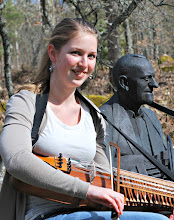
    The nyckelharpa is an intriguing Swedish folk music instrument. .Several hypothesises exist about its origin: is it brought from Germany, or perhaps from Belgium? Or is it a genuine Swedish 'invention'?


  • Early church paintings

    Depictions in churches of angels playing nyckelharpa show that the instrument had a certain status in the Middle Ages. Early paintings are mainly found in Sweden. This photo is made in Tolfta, Uppland.


  • Early church paintings

    Tolfta, Uppland.


About the Blog

Hi, welcome on my blog about the nyckelharpa! I'm Janine Buisman, musicologist, IT project manager, garden designer and above all a nyckelharpa player from the Netherlands.

With this blog I want to give you a source of information regarding the nyckelharpa. Here you can find blog posts about the instrument in general, on (coming) workshops and courses, music with or for nyckelharpa, interesting literature, etc. Feel free to comment - and enjoy!

Would you like to contact me? Please leave a message in the contact form below.
Showing posts with label Literature. Show all posts

Thursday, 13 October 2016

13th International Days of the Nyckelharpa

0 reacties
Every year in October the castle Burg Fürsteneck in central Germany is filled with nyckelharpa players from all over the world. They all come for the International Days of the Nyckelharpa where you can join continuous and short nyckelharpa workshops on different topics.

Quite often I heard people enthusiastically speaking about this annual event, but so far I'd never attended it, yet. After having played nyckelharpa for almost six years, it's definitely time to go there! Getting there did initially not go particularly smoothly due to car problems: instead of travelling for about 6 hours, it took almost 12 hours to get there... But wow, the weekend was definitely worth the long trip! Around 80 nyckelharpists from 13 different countries all crammed together into the medieval castle in Eiterfeld.

Workshop Didier François (Photo by Karsten Evers)
After the welcome speech and the introduction of all the wonderful teachers, the workshops started in the late evening. This years teachers were Ana Alcaide (ES), Marco Ambrosini (IT/DE), Jule Bauer (DE), David Eriksson (SE), Didier François (BE), Magnus Holmström (SE), Johannes Mayr (DE), and Annette Osann (FR). I had the privilege of taking part in the workshop given by Didier François on "Groovy arrangements and improvisations on European folk music". During his workshop many different aspects of playing were discussed: from improvisation techniques on scales and arpeggios to intrinsic motivation (f.e. the power of thinking positive). In the group we worked on a.o. blues and folk music from Macedonia, Bulgaria, Hungary and Bosnia - so different from the traditional Swedish folk music I normally play on nyckelharpa.

On Friday and Saturday afternoon everyone had the opportunity to take part in short workshops of about an hour, with the same or another teacher. I first took part in the short workshop by Marco Ambrosini on polyrythmical playing (like gamelan music from Indonesia). At first this polyrhythmical playing felt so unnatural, but at the same time very intriguing! Really fun to play together in this way! Next day I chose the short workshop by Ana Alcaide. She taught us two beautiful sephardic songs. Personally, I especially love the melody of Por que llorax blanca niña.

The surrounding landscape
For some fresh air and movement there was also enough opportunity during the lunch breaks. The weather was perfect for a delightful walk through the sunny fields of Eiterfeld. Dark blue clouds at the horizon gave even more autumnal colour to the beautiful hilly landscape.

Getting bored at Burg Fürsteneck is just impossible! Even in the evenings there's lot to do, see, play, listen, or people to meet. Friday evening started with the interesting Nyckelharpa Conference on recent developments. First Magnus Holmström discussed the in Sigtuna found object from the 12th century, which very likely might be a nyckelharpa key! Although many objects were discovered during the excavation besides the market, only one key was found, or preserved. I'm curious what a carbon dating will tell us more. Next Per-Ulf Allmo spoke about his newly written publication on the history of the nyckelharpa, titled 'Framlades then stora Nycklegijga: En avhandling om den svenska nyckelharpans tillkomst'. Although I haven't finished reading it yet, I can highly recommend his book. The book, though, is only published in Swedish but in time a summary in English (and probably also in German) will follow.

Teachers concert (Photo by Karsten Evers)
After another wonderful workshop day, the hall of the castle swiftly filled with visitors for the concert Saturday evening. The concert started with the participants of the European Nyckelharpa Training, from both the Italian as the German track. The second part of the concert was given by the teachers. Wow, the concert was sooo beautiful! During the whole event there was also a nice exhibition/forum for builders where you could try other instruments and bows. I was impressed by the beautiful snakewood bows made by the French bow maker Aurélie Georges. And of course, what's a music weekend without wonderful jam sessions until very, very late!? Learned some lovely new tunes there after midnight.

All by all, the International Days of the Nyckelharpa is a perfect event to learn more about the versatility of the instrument, try other nyckelharpa's and bows, listen and play beautiful music, and meet amazing people. Don't doubt, go there next year!

The final presentation of all workshop groups (Photo by Karsten Evers)


Read more

Thursday, 7 July 2016

Read, watch & learn

0 reacties
In finishing my bachelor study in Musicology at the University of Utrecht in 2011, I wrote my thesis on the global development of the nyckelharpa. Below you'll find the literature specifically regarding the nyckelharpa which I've used for my thesis, plus new publications and literature regarding playing and building. So, material which might be interesting or useful to you.

Are you missing something in the listing? Please let me know.

Literature

  • Ahlbäck, Gunnar (1980). Nyckelharpfolket: om nyckelharprörelsen, en 1970-talsföreteelse, historia och bakgrund, framväxt och utbredning. Stockholm: LTs förlag.
  • Ahlbäck, Gunnar, ed. (1992). Boken om Eric Sahlström. Tierp: Eric Sahlströms Minnesfond.
  • Ahlbäck, Gunnar, Fredelius, Gunnar, en Jan Ling (1991). Nyckelharpan nu och då/The Nyckelharpa Present and Past. Stockholm: Musikmuseet.
  • Allmo, Per-Ulf (2016). Framlades then stora Nycklegijga: En avhandling om den svenska nyckelharpans tillkomstTullinge: Tongång.
  • Allmo, Per-Ulf (2004). Den gäckande nyckelharpan: En studie i instrumentets tillkomst. Tullinge: Tongång.
  • Andersson, Otto E. (1930), The bowed-harp: A study in the history of early musical instrumentsLonden: William Reeves.
  • Boström, Mathias (1999). Nyckelharpan och nätet: om sociala och elektroniska nätverk kring nyckelharpan. Stockholm: The Royal Swedish Academy of Music.
  • Eriksson, Maj-Britt (1956). Melodi på nyckelharpa. Stockholm.
  • Evers, Karsten (Ed.) (2011). CADENCE: Cultural adult education and nyckelharpa cooperation in EuropeVerlag der Spielleute / Förlaget Tongång.
  • Hettrick, William (1994). The ‘Musica instrumentalis deudsch’ of Martin Agricola. A treatise on musical instruments, 1529 and 1545. Cambridge: Cambridge University Press.
  • Hogmark, Esbjörn (2020). Nyckelharpan: ett unikt svenskt kulturarv. Göteborg: Bo Ejeby Förlag.
  • Isaksson, Olov (1998)Vallonbruksminnen. Stockholm: En bok för alla.
  • Leffler, Karl Peter (1899). Om nyckelharpospelet på Skansen. Stockholm: Nordiska Museet.
  • Ling, Jan (1976). Nyckelharpan. Studier i ett folkligt musikinstrument. Stockholm: Bokförlaget Prisma.
  • Ling, Jan (1997). A History of European Folk MusicRochester: University of Rochester Press.
  • Praetorius, Michael (1619). Syntagmatis musici tomus secundus: De organographia. Wolfenbüttel. Facsimile reproduction by Wilibald Gurlitt (Kassel: Bärenreiter, 1958).
  • Ralyea, John (1980). Shepherd's delight: guide to repertoire for hurdy-gurdy, musette (bagpipes), organized hurdy-gurdy, wheel-fiddle, keyed fiddle (nyckelharpa), and marine trumpet. Chicago: The Hurdy-Gurdy Press.
  • Risberg, Bernhard (1908). På nyckelharpa och violin. Stockholm: Ljus.
  • Tärnström, Anne-Marie (1994). Nyckelharpan: en bibliografiVällingby.
  • Virdung, Sebastian (1511). Musica getutscht und ausgezogen durch Sebastianum Virdung Priesters von Amberg und alles Gesang auss den Noten in die Tabulaturen diser benanten dryer Instrumenten der Orgeln, der Lauten und der Flöten transferieren zu lernen Kurtzlich gemacht zu Er-en den hoch wirdigen hoch gebornen Fürsten  und herren: Herr Wilhalmen Bischove zü Straszburg, seynem gnedigen herren. Basel: Michael Furter.

 Articles

  • Abbot, Djilda, & Ephraim Segerman, 'Strings in the 16th and 17th Centuries', Galpin Society Journal vol. XXVII, 1974; corrected: Northern Renaissance Instruments, Research Report No.2Manchester, September 1974.
  • Allmo, Per-Ulf. “Moraharpans väg till Mora: ett bidrag til frågan om Dalaharpornas ålder  och härkomst.” Musikk og tradisjon: tidsskrift for forskning i folkemusikk og folkedans 24 (2010), pp. 100-129.
  • Engsås, Jan. “Som nyckelharpa bland svartrockarna: en introvert betraktelse”, Nyckelposten (1994), pp. 4-6.
  • Fichtenbaum, Matt. “The nyckelharpa: Sweden's unique folk instrument”, Fiddler magazine (1996), pp. 29-31.
  • Fredelius, Gunnar. “VM i nyckelharpa 1996”, Nyckelharpan (1996), pp. 11-13. 
  • Fredelius, Gunnar. “VM i nyckelharpspel”, Nyckelposten (1994), pp. 8-12.
  • Hedin, Johan. "Tenornyckelharpan - en udda figur i nyckelharpvärlde." (2004). Click here for the article.
  • Hedin, Johan. "The Tenor Nyckelharpa – a new presence in the nyckelharpa world." (2004). Click here for the article.
  • Hedin, Johan. "Lutnyckelharpan." (2005). Click here for the article.
  • Hogmark, Esbjörn. “Nyckelharpan i Dalarna inte riktigt rumsren än?”, Dalarnas spelmansblad, 2/1983, pp. 14–15.
  • Hogmark, Esbjörn. “Tre- eller fyrradig nyckelharpa?”, Spelmannen 4/1983, pp. 10–11.
  • Holmström, J. “Byss-Kalle. Musikaliskt geni på harpa”, Uplandsspelmannen 1 (1976).
  • Jirka, Rudolf R.. “Die Nyckelharpa: Schwedens Volksmusikinstrument”, Concerto Nr.93 (1994), pp. 16-19.
  • Kantor, J. “Från svarven till nyckelharpan”, Metallarbetaren 32 (1979).
  • Kjellström, Birgit. "Om folkliga instrument". In: Ling, Jan, Ramsten, Märta, & Gunnar Ternhag (1980). Folkmusikboken, Prisma. Click here for the article.
  • Klein, E. “Nyckelharpor.” Uppland i Nordiska Museet och Upplandsmuseet (1926), pp. 73–76.
  • Kuoppala, Mats. “Nyckelharpan – farsot eller förnyelse?”, Tonfallet 11-12 (1976).
  • Myers, Karen. "The Swedish Nyckelharpa in Its Historic Context", (2006).  Click here for the article.
  • Nilsson, Bertil. “Östgötsk herrgårdsharpa”, Nyckelharpan (1996), pp. 4-6.
  • Nilsson, Bertil. “Te och nyckelharpa i London”, Nyckelharpan (1992), pp. 8-9.
  • Paulsson, Olle. “Världsmästare på nyckelharpa”, Nyckelposten (1990), pp. 8-9.
  • Psilander, A. “Berömda upplandsspelmän”, Gefle Dagblad, 10 and 12 November 1908.
  • Rosén, Anders. “The Nyckelharpa”, Hurv Musik (September 2000).
  • Rudbeck, Ture Gustaf. “Carl XI:tes stuga i Elfdalen”, Skandia, Nordisk National Kalender (1850).
  • Svensson, S.E. “Nyckelharpan och nyckelharpaspelet i gamla tider och nu”, Upsala Nya Tidning: Julnummer (1950).
  • Ternhag, Gunnar. “The story of the Mora-harp: museumisation and de-museumisation”, Tautosakos darbai XXXII (2006), pp. 138-147. Click here for the article.
  • Ternhag, Gunnar, & Mathias Boström. “Nyckelharpan: ett musikinstrument i vallonernas famn”, (1998).
  • Ternhag, Gunnar, & Mathias Boström. “The dissemination of the nyckelharpa: the ethnic and the non-ethnic ways”, Svenska samfundet för musikforskning (1998). Click here for the article.
  • Tärnström, Anne-Marie. "Nyckelharpa i skilda världar", Nyckelharpan (1997), pp. 7-8.

Literature on playing

  • Alpsjö, Leif (1978). Spela nyckelharpa: beskrivningar, noter och sifferskrift. Östervåla.
  • Ambrosini, Marco (2012). Nyckelharpa exercises for daily practice. Verlag der Spielleute / Förlaget Tongång.
  • Bauer, Jule (2013). Playing the Nyckelharpa Spielen. Verlag der Spielleute / Förlaget Tongång.
  • Bauer, Jule, François, Didier, & Marco Ambrosini (2013). Nyckelharpa: Symbols and Notation. Reichelsheim: Verlag der Spielleute. Click here for the book.
  • Fichtenbaum, Matt. “Första steget mot stämspel”, Nyckelharpan (2001), pp. 8-11.
  • Kuoppala, Mats (1976). Att spela nyckelharpa: vägledning. Stockholm/Solna.
  • Suppo, Marco (2015). Tablatures for 4-row Chromatic NyckelharpaVerlag der Spielleute / Förlaget Tongång.

Literature on building

  • Bäckström, Lars (1976). Kromatisk nyckelharpa: byggbeskrivning och ritning. Stockholm.
  • Hermansson, N. (1973). Kromatisk nyckelharpa: ritning. Uppsala.
  • Hogmark, Esbjörn (2020). Nyckelharpan: ett unikt svenskt kulturarv. Göteborg: Bo Ejeby Förlag.
  • Lundin, Herold, & Daniel Kviberg (1974). Nyckelharpa och hur du kan bygga den. Solna.
  • Sanborn, Gunnar (1983). Akustiskt fiolbygge: med gitarrens , nyckelharpans och stråkens akustik. Halmstad: Spektra.
  • Åhker, Sören (1998). Bygg Sveriges nationalinstrument: en bygginstruktion. Stockholm: Författares Bokmaskin.
  • Åhker, Sören (2002). Chromatic nyckelharpa: a construction manual. Stockholm: Författares Bokmaskin.

 Audiovisual

  • Build a Nyckelharpa with Sören ÅhkerDocumentary. Produced by Rita Leydon. 2002.
  • The Nyckelharpa Strikes Back. Documentary. Directed by Christian Catomeri. SVT, European Broadcasting Union, 2004.
  • Peter Hedlunds Nyckelharpskola, Volume 1-3. Instruction DVD. Produced by Rita Leydon. 2001-2004.

 Newsletters

  • Nyckelharpan (Föreningen Nyckelharpans member newsletter)
  • Nyckel Notes (newsletter of the American Nyckelharpa Association). Click here for the newsletter.


Read more